
Unlock New Possibilities for Storage Upgrades: SAS-to-SATA Adapters Ensure Seamless Hard Drive Compatibility
What is a SAS-to-SATA Adapter? The Essential Bridge for SMB Storage Upgrades
In the realm of servers and data storage, have you ever faced this dilemma: owning high-performance SATA hard drives, yet your server motherboard or RAID controller only offers SAS interfaces? Or, during equipment upgrades, having to retire perfectly functional hardware due to incompatible interface standards? This is where a compact yet powerful tool—the SAS to SATA adapter—emerges as the perfect solution to resolve conflicts and save costs.
Simply put, a SAS to SATA adapter (also known as a SAS to SATA converter) is a physical interface converter. It transforms the SAS (Serial Attached SCSI) controller or backplane interface into one compatible with SATA (Serial ATA) hard drives. This goes beyond mere pin-to-pin conversion; it enables compatible communication between different protocols. This allows more affordable, higher-capacity SATA drives to seamlessly integrate into professional systems originally designed for SAS drives.
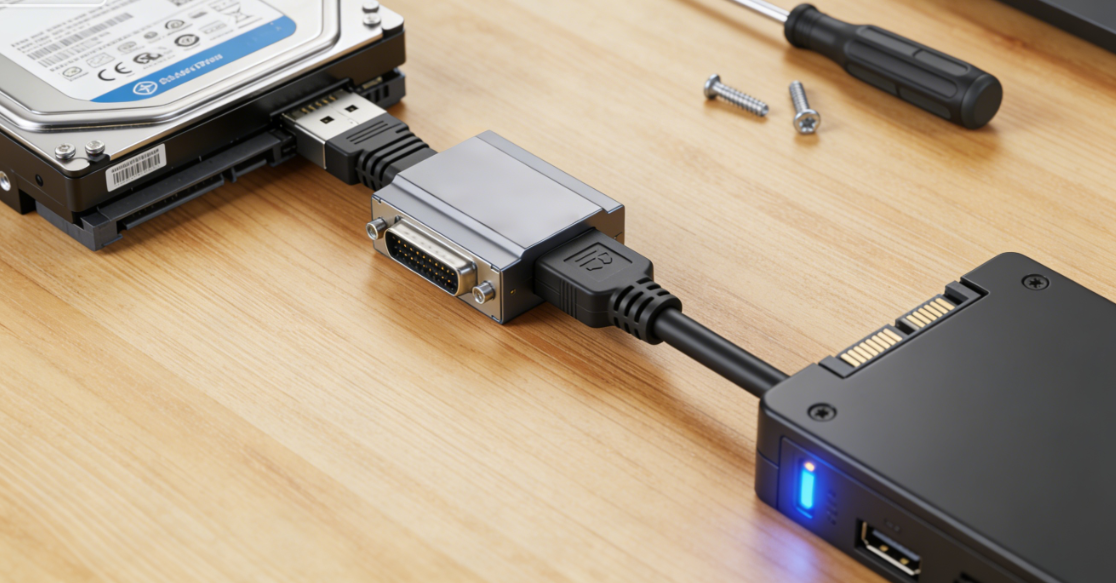
Why Use a SAS to SATA Adapter? Core Application Scenarios Explained
Server Storage Expansion and Cost Control
Enterprise servers, especially older models, often feature SAS interfaces. While SAS drives offer reliable performance, their cost significantly exceeds that of equivalent-capacity SATA drives. When expanding storage for high-capacity backup, archival, or server systems, using a SAS-to-SATA adapter with large-capacity enterprise-grade SATA drives achieves storage goals at a lower cost—making it an ideal choice for budget-sensitive projects.
Data Recovery and Hardware Reuse
Data recovery labs and IT maintenance departments frequently encounter drives with different interfaces requiring access. This adapter enables SAS-equipped drive enclosures or servers to directly read SATA drive data, significantly enhancing tool compatibility and workflow efficiency. It also revitalizes SAS backplanes from retired servers, allowing them to be repurposed for building SATA-based test platforms or temporary storage systems.
Flexible Hybrid Storage Environment Setup
In advanced applications, users may seek to mix SAS and SATA drives within the same storage system—dedicating SAS for high-I/O critical applications and SATA for large-capacity cold data. SAS-to-SATA adapters enable more flexible utilization of drive bay slots, optimizing storage tiering strategies.
Key Considerations for Selecting SAS-to-SATA Adapters
With numerous products available, how do you choose a reliable and suitable SAS-to-SATA adapter? Focus on these core elements:
Interface Gender and Direction: Confirm whether you need a “SAS male to SATA female” or a “SAS backplane to SATA male” adapter. The most common configuration converts a SAS controller (male) to connect with a SATA hard drive (female).
Protocol Compatibility and Speed: Ensure the adapter supports SAS 2.0 (6Gb/s) or SAS 3.0 (12Gb/s) standards while maintaining backward compatibility with SATA III (6Gb/s). High-quality adapters guarantee stable signals without speed degradation.
Chip and Manufacturing Quality: Opt for products using proven bridge chips, paying attention to PCB manufacturing quality and shielding design. Inferior adapters may cause unstable recognition, transmission errors, or even device damage.
Cable Length and Additional Features: Some products feature direct connectors, while others include short cables for greater installation flexibility. Some also integrate LED activity indicators for easy hard drive status monitoring.
Usage Precautions: Ensuring Stability and Performance
Power Considerations: SAS interfaces typically do not supply power to drives via data ports. When connecting SATA drives, always use a standard SATA power cable to ensure adequate and stable power delivery.
Functional Limitations: Adapters primarily address connectivity issues. Advanced management features of certain SAS controllers (e.g., complex multipath I/O) may not function fully when connected to SATA drives.
System Recognition: In RAID configurations, SATA drives connected via adapters are usually recognized by controllers as standard SATA devices. Confirm and configure settings through the controller management interface (e.g., RAID card BIOS).
Heat Dissipation and Mounting: During installation in compact server spaces, carefully route adapters and cables to avoid obstructing airflow paths and ensure secure connections.
In summary, though a small accessory, the SAS-to-SATA adapter plays an indispensable role in enterprise IT resource consolidation and cost optimization. It breaks down storage interface barriers, granting system builders greater flexibility and freedom. Whether upgrading servers, performing data recovery, or building test environments, selecting a high-quality adapter can make your storage solutions twice as effective with half the effort, effortlessly maximizing hardware value.
In this era where data reigns supreme, let the SAS-to-SATA adapter become your trusted ally in intelligent storage management, ushering in a new chapter of efficient and compatible storage solutions.