
Slim SAS Connectivity Solution: Redefining the New Standard for High-Density Interconnects in Data Centers
As data centers evolve toward higher density and bandwidth, traditional connectors face physical space and performance bottlenecks. Slim SAS cables and interfaces, as an innovative high-density interconnect solution, are rapidly becoming the next-generation key technology for servers, storage, and accelerated computing.
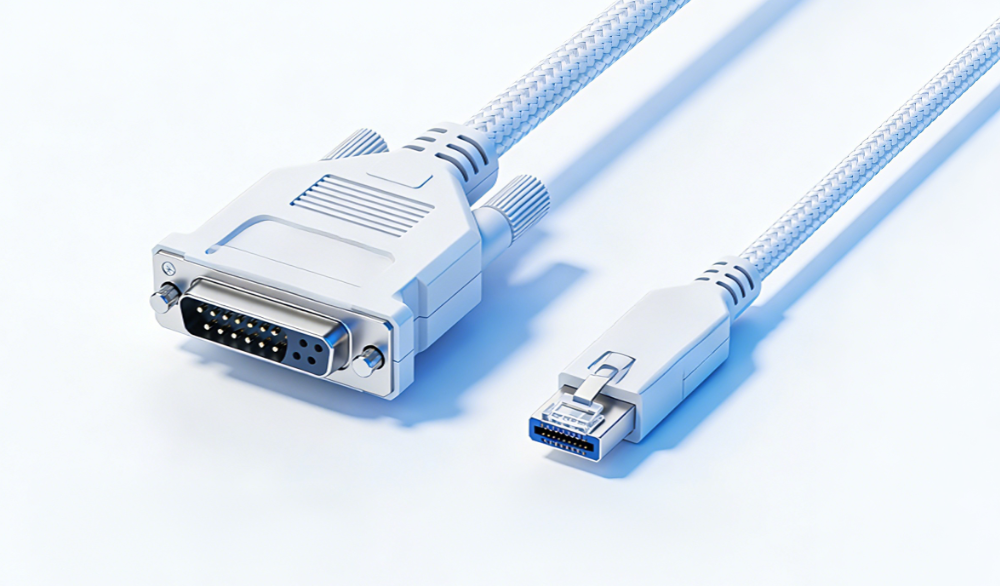
Slim SAS Technology Evolution: Why It's the Ideal Successor to Mini SAS?
Traditional Mini SAS (e.g., SFF-8643/8644) excelled during the SAS-3 (12 Gbps) era. However, as PCIe 4.0, PCIe 5.0, and faster standards gain traction, its interface size and channel density increasingly fail to meet demands.
Slim SAS cables (often specified as SFF-8654, SFF-8611, etc.) emerged as a solution. Its core advantages include:
Smaller physical footprint: Delivers higher port density than Mini SAS HD within a comparable width.
Higher bandwidth: Native support for PCIe 4.0 (16 GT/s per lane) and PCIe 5.0 (32 GT/s), enabling a single x8 lane cable to deliver up to 128 Gbps of effective bandwidth.
Protocol flexibility: Seamlessly supports SAS, SATA, and PCIe protocols, making it ideal for connecting NVMe U.2/U.3 drives, GPU expansion cards, and high-speed storage backplanes.
In-Depth Analysis of Slim SAS Interfaces and Cables: Types and Application Scenarios
Understanding Slim SAS types is crucial for proper selection. It primarily consists of two physical interface types, each suited for different scenarios.
Slim SAS Internal Interface (Type A, SFF-8654)
This is the most common internal Slim SAS cable type.
Interface Features: Dual-row, high-density pins; no metal housing; secured via side clips.
Core Applications: Primarily used for internal chassis connections.
Connecting motherboards/HBAs to NVMe drive backplanes: A single x8 Slim SAS cable can support two U.2 NVMe drives (x4 lanes each).
Connecting GPU accelerator cards or expansion cards: Used for high-speed interconnects between CPUs and GPUs or accelerators in AI servers and high-performance computing nodes.
Slim SAS External Interface (Type B, SFF-8611)
Designed for high-speed external device interconnects.
Interface Features: Features a rugged metal shielded housing with a push-pull self-locking mechanism for dust protection, accidental contact prevention, and high reliability.
Core Applications: Enables short-distance high-speed connections between servers in cabinets and all-flash storage arrays, JBOD expansion enclosures, or NVMe-oF conversion devices.
How to Select the Right Slim SAS Solution for Your Project?
Facing complex deployment requirements, proper selection ensures system stability and maximized performance.
Define Protocol and Bandwidth Requirements
Confirm whether your devices (motherboard, HBA card, hard drives) support PCIe 4.0 or PCIe 5.0. This determines whether you need a SlimSAS PCIe 4.0 cable or a PCIe 5.0 cable, as they have different signal integrity requirements.
Distinguish Between Internal and External Applications
For chassis internal cabling, select a SlimSAS internal cable Type A.
For cross-device connections, always use SlimSAS external cable Type B with a metal locking shell.
Consider Lane Configuration (x4, x8, x16)
x4 configuration: Commonly used for connecting a single high-performance device.
x8 configuration: Currently the most mainstream option, offering high flexibility through divisible usage.
x16 configuration: Delivers ultimate bandwidth for scenarios demanding peak performance.
Consider cable length and quality
Short distances (≤3 meters) can be adequately served by high-quality passive copper cables.
For longer distances or extremely high-frequency applications (e.g., PCIe 5.0), active cables should be considered to ensure signal integrity.
Empowering the Future: Slim SAS's Core Role in AI and Hyper-Converged Infrastructures
Slim SAS connectivity solutions represent not just a cable upgrade, but an architectural empowerment. In AI servers, it serves as the high-speed data pathway between CPUs and multiple GPUs. In hyper-converged infrastructure, it enables ultra-low latency interconnects between compute nodes and NVMe storage pools.
Its high-density characteristics empower data centers to deploy more compute and storage units within limited space, directly reducing TCO (Total Cost of Ownership). Its high bandwidth and multi-protocol support capabilities reserve ample room for technological evolution, safeguarding investments.
The evolution from traditional Mini SAS to Slim SAS cabling represents an inevitable choice for data centers pursuing higher performance and denser deployments. Whether designing next-generation AI servers or deploying all-flash storage systems, gaining a deep understanding of Slim SAS interface types and their applications is a critical step in ensuring advanced and reliable system architecture. Selecting the right Slim SAS solution lays the foundation for future-proof, high-speed interconnects in your data center.