
Key Considerations for Choosing Slim Cables: Balancing Portability, Durability, and Transfer Speed
In today's era of ubiquitous electronic devices, slim cables have become essential accessories for commuting, office work, and home use thanks to their compact, lightweight design. Whether charging phones, transferring files on computers, or connecting tablets and cameras, our expectations for Slim Cables extend far beyond basic connectivity. We now demand portability without bulk, rugged durability, and efficient, lag-free data transfer. Yet the market is flooded with diverse options, and low-quality cables often suffer from issues like brittleness, slow speeds, and cumbersome storage—leading many shoppers to make poor choices. Today, we'll outline the core selection criteria for Slim Cables, guiding you to quickly identify cost-effective products that balance portability, durability, and transfer speed while avoiding common pitfalls.
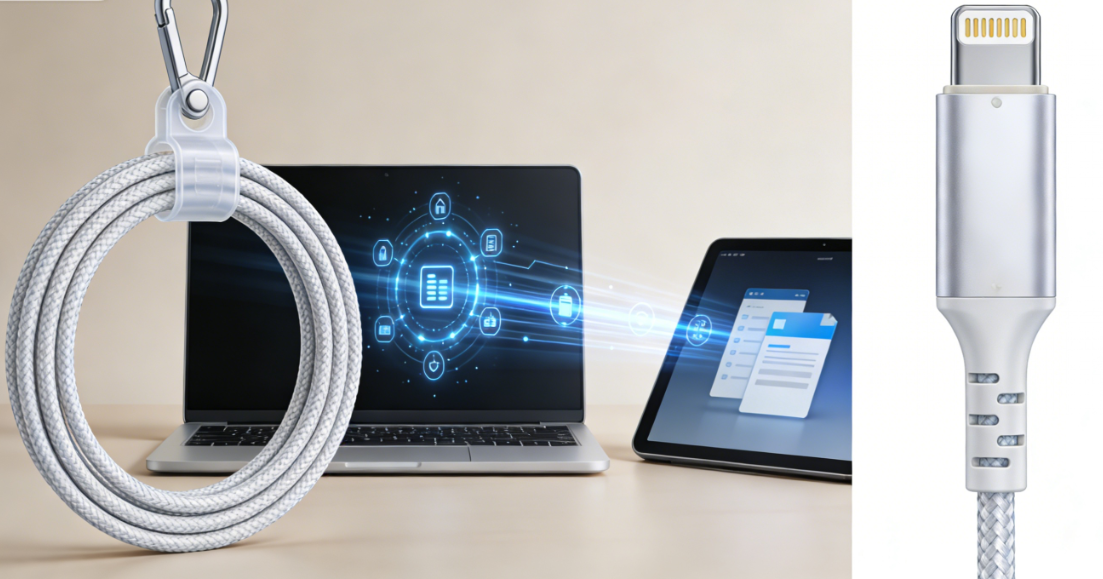
Core Selection Criteria: Balancing Portability, Durability, and Speed
The essence of choosing a Slim Cable lies in “balance”—don't sacrifice durability for ultra-thin portability, don't overlook transfer speed for sturdiness, and certainly don't pursue high speed at the cost of bulkiness. Each of the following three key points directly impacts your user experience and deserves close attention.
Portability: Slim Profile + Flexible Storage for Multi-Scenario Use
Portability is the core strength of slim cables. When selecting, prioritize “slimness, flexibility, and length suitability.” Truly portable cables are “space-saving, easy to store, and tangle-free.”
First, examine slimness. Premium Slim Cables typically feature an outer diameter under 5mm—over 45% slimmer than traditional cables. They effortlessly fit into phone cases, wallets, or keychain slots without occupying extra backpack space, eliminating the need for separate storage pouches when traveling. Next, consider flexibility. Opt for cables made from flexible materials like TPE or PET. These materials are soft and bendable, with a minimum bending radius of just 6 times the cable's outer diameter. They can be freely folded or coiled without tangling, won't develop kinks from bending, and maintain their shape even after repeated storage.
Finally, consider length suitability for different scenarios: Commuters should prioritize 0.5-1 meter lengths—compact and unobtrusive, easily slipping into a pocket. Office workers may opt for 1-1.5 meters, balancing desktop usability and storage without excessive cable clutter. Home users can choose 1.5-2 meters for bedside or desk setups, minimizing device relocation. Avoid excessively long Slim Cables, as this compromises their core advantage of ultra-thin portability and increases tangling risks.
Durability: Dual-Focus on Materials & Craftsmanship to Break the “Fragile Curse”
Many users report “ultra-thin cables breaking easily,” but the root cause lies in materials and manufacturing—high-quality Slim Cables achieve “ultra-thin without fragility,” while low-quality products cut corners to reduce costs, leading to breakage and poor contact. When selecting, focus on three key details: outer sheath material, conductor material, and connector craftsmanship.
Prioritize TPE (Thermoplastic Elastomer) or low-smoke, halogen-free elastomeric compounds for the outer sheath. These materials offer flexibility alongside abrasion resistance, aging resistance, and tensile strength. Compared to traditional PVC, they withstand bending better, resist cracking, and won't yellow or harden over time. They also boast eco-friendly, low-toxicity properties for safer use. For frequent outdoor use, consider Slim Cable with a braided outer layer. The braid further enhances tear resistance and abrasion protection, preventing cable damage from scratches or snags.
Conductor material directly impacts durability and transmission stability. Prioritize tin-plated annealed copper or oxygen-free copper conductors. These materials offer superior conductivity alongside oxidation and corrosion resistance, reducing contact issues over time. They also provide greater flexibility, preventing core breakage from repeated bending. Avoid copper-clad aluminum conductors, as they are brittle, prone to breakage, and have poor conductivity. Long-term use may lead to transmission stuttering and slower charging.
The connector interface is a “high-risk zone for breakage.” Premium Slim Cables feature “reinforced connector processing,” such as using an integrated molding process and a reinforced mesh tail design. The mesh tail section cushions bending forces, preventing fractures at the cable-connector junction caused by repeated bending. Additionally, gold-plated or tin-plated connectors enhance transmission efficiency and oxidation resistance, preventing tarnishing, poor contact, and extending service life.
Transfer Speed: Protocol + Parameter Comparison for Efficient Performance
Slim cables shouldn't prioritize thinness alone—transfer speed and charging efficiency matter equally. This is especially crucial for users frequently transferring large files (photos, videos, documents) or requiring fast charging, as transfer speed directly impacts productivity. When selecting, focus on “transfer protocol, speed parameters, and charging power” to avoid misleading “high-speed” marketing claims.
First, examine the transmission protocol and select the appropriate one for different uses: For daily charging and standard file transfers, the USB 2.0 protocol suffices, offering transfer speeds up to 480Mbps, suitable for devices like smartphones and tablets. For frequent transfers of high-definition videos or large documents, prioritize high-speed protocols like USB 3.2 or Thunderbolt 4. These offer transfer rates exceeding 10Gbps, enabling near-instantaneous transfers of HD videos. Pairing with devices supporting high-speed transfer doubles efficiency. Note: Transfer speed depends not only on the cable but also on device compatibility with the protocol. Verify your device's maximum supported protocol before purchasing to avoid wasting money on cables that exceed your device's capabilities.
Next, consider charging power based on your devices: - Smartphone users should prioritize Slim Cables supporting 20W+ fast charging for rapid top-ups and reduced charging time. - Tablet and laptop users can opt for 30W-65W fast-charging cables that balance charging and data transfer needs. Avoid products with “misleading power ratings.” Quality cables clearly state both charging power and data transfer rates—exercise caution with unlabeled or ambiguously labeled products.
Additionally, for professional settings like data centers or research labs, prioritize Slim Cables meeting Cat6a or higher standards. These ensure high-speed data transfer, enhance heat dissipation, and suit high-density cabling scenarios. Verify that cables carry authoritative certifications like UL or ETL to guarantee stable and reliable performance.
Buying Pitfalls Guide: 4 Common Mistakes to Avoid
Misconception 1: Thinner is Better
Many assume thinner Slim Cables offer greater portability, yet overlook durability—excessively thin cables feature thinner conductors and outer jackets, making them prone to core breakage and cracking. High-quality Slim Cables strike a balance between thinness and resilience, typically with an outer diameter between 3-5mm. This ensures portability while maintaining durability, avoiding the pitfall of blindly pursuing “ultra-thin extremes.”
Misconception 2: Higher Price Equals Better Quality
Slim Cable pricing is influenced by materials, craftsmanship, and brand reputation, but higher cost doesn't guarantee superiority. Some niche brands offer premium products using identical materials and techniques at 30%-50% lower prices than major labels, delivering better value. Conversely, certain big-name products carry excessive markups with minimal performance gains over affordable alternatives. Focus on specifications and materials when selecting, not just price tags.
Misconception Three: Neglecting Scenario Compatibility
Different scenarios demand distinct Slim Cable features. Commuters don't need excessively long cables, outdoor enthusiasts require durable braided designs, and professional settings demand high-speed protocol versions. Blindly choosing universal models may lead to issues like “insufficient portability,” “poor durability,” or “subpar transfer speeds.” Selecting cables based on specific needs enhances the user experience.
Misconception Four: Overlooking Certifications and After-Sales Support
High-quality Slim Cables carry relevant certifications (e.g., USB-IF certification) and offer robust after-sales guarantees (e.g., one-year warranty, replacement services). Inferior products lack certifications and after-sales support, leaving users without recourse when issues arise. Prioritize products with clear certifications and comprehensive after-sales support to avoid purchasing substandard items at low prices that ultimately increase usage costs.
Prioritize Needs and Balance Three Core Requirements
The core logic of selecting a Slim Cable is “balance”: - Portability: Consider slimness, flexibility, and length - Durability: Evaluate outer sheath, conductor material, and connector craftsmanship - Transfer Speed: Assess protocol, data rate, and charging power By aligning with your usage scenarios (commuting, office, home, professional settings), combining core + long-tail keywords in your search, and avoiding the four pitfalls above, you can swiftly identify a high-value Slim Cable.
Lastly, remember: a quality Slim Cable not only enhances your experience but also extends device lifespan by preventing damage from subpar cables. May this guide help you avoid pitfalls and effortlessly find a Slim Cable that balances portability, durability, and speed—ensuring every connection is efficient, convenient, and worry-free.