
Enterprise IT Procurement Guide: When to Choose PowerEdge Rack Servers? When to Consider Blade Systems?
The Flexible Foundation of Rack Servers: Core Advantages of PowerEdge Rack Servers
As the most classic deployment form in data centers, rack servers continue to be favored by enterprises for their exceptional flexibility and scalability. The Dell PowerEdge rack server series offers comprehensive solutions ranging from single-socket to quad-socket configurations, and from general-purpose computing to high-performance computing, making them particularly well-suited for modular growth requirements. Their independent operation allows hardware upgrades, maintenance, and replacements without affecting other devices, providing an ideal balance for small and medium-sized businesses or distributed deployments.
The advantages of PowerEdge rack servers are especially pronounced in heterogeneous environments. When enterprises need to deploy servers with different configurations and purposes, the rack design allows mixed deployments without concerns about unified infrastructure compatibility. Each server can be independently equipped with customized storage, memory, and expansion cards—a flexibility that proves crucial when running diverse workloads.
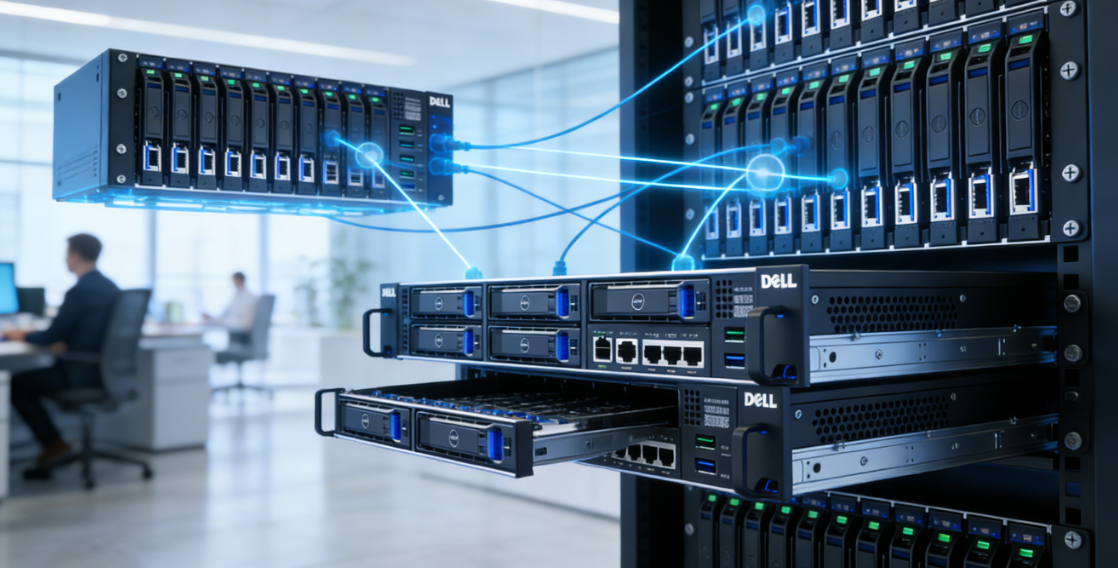
The Power of Blade Systems: The Professional Choice for Efficient, Dense Deployment
Blade server systems represent an advanced form of data center consolidation. By sharing infrastructure such as power, cooling, and network connections, they achieve unprecedented space and energy efficiency. Dell PowerEdge blade systems can house multiple server modules within a single chassis, making them particularly well-suited for large-scale, homogeneous workload deployments.
Blade systems deliver unique value when organizations face challenges like limited rack space, constrained power supply, or the need to simplify management of numerous servers. Shared infrastructure not only reduces cabling complexity but also significantly lowers operational overhead through a unified management interface. For rapidly expanding compute demands, blade systems enable hot-swappable expansion, making the addition of new server modules exceptionally straightforward.
Scenario-Based Decision Making: Five Key Dimensions for Precise Selection
Assessing Workload Characteristics
Opt for PowerEdge rack servers when: Your workloads are diverse, requiring specialized hardware configurations or independent upgrade cycles. Examples include running different database versions, needing specific GPU accelerators, or utilizing specialized storage controllers.
Consider blade systems when deploying large numbers of homogeneous compute nodes, such as virtualization clusters, HPC nodes, or large-scale web server farms. Blade systems deliver consistent management and deployment experiences for standardized workloads.
Analyzing Scaling Patterns
Choose rack servers when your IT infrastructure exhibits incremental, unpredictable, or heterogeneous scaling patterns. Rack servers allow you to add individually configured nodes as needed without pre-planning entire systems.
Consider blade systems when: You can predict expansion needs for the next 12-24 months and plan phased bulk purchases. Blade systems require an initial chassis investment but deliver significant marginal cost efficiency at scale.
Evaluating Infrastructure Conditions
When to choose rack servers: Your data center has ample space but limited power or cooling capacity. Modern high-density rack servers deliver powerful computing within constrained power limits, while independent cooling designs offer greater flexibility.
When to consider blade systems: Rack space is your most constrained resource, but power supply is sufficient. Blade systems share power and cooling, enabling deployment of more compute cores per unit space—achieving over 40% higher space utilization.
Evaluating Management Complexity
When to choose rack servers: Your IT team prefers a divide-and-conquer management strategy, or requires assigning different servers to separate departments/projects for independent management. The autonomous nature of rack servers simplifies responsibility allocation.
When to consider blade systems: You aim to centrally manage large server fleets, monitoring hardware health, deploying operating systems, and allocating resources through a unified interface. Blade systems' integrated management modules significantly reduce daily operational workloads.
Calculating Total Cost of Ownership (TCO)
When to choose rack servers: When initial investment budgets are constrained or capital expenditures need to be spread out. Rack servers eliminate upfront chassis costs and offer lower per-unit procurement prices, making them suitable for phased investments.
When to consider blade systems: When focusing on long-term operational costs, including power, cooling, and management labor expenses. Though blade systems require higher initial investment, their energy efficiency and management effectiveness deliver significant long-term savings at scale.
Hybrid Strategy: The Smart Solution Balancing Flexibility and Efficiency
Modern enterprise data centers need not be an either/or proposition. Many successful organizations adopt hybrid deployment strategies: using PowerEdge rack servers for specialized workloads and edge deployments, while deploying blade systems in core data centers for standardized, high-density computing tasks.
For example, Virtual Desktop Infrastructure (VDI) can run on blade systems for optimal density and management efficiency, while SQL database servers are deployed on high-performance rack servers to independently scale storage and memory configurations. Dell's unified OpenManage management platform ensures consistent management across hybrid environments, breaking down architectural boundaries.
Technology Choices Aligned with Business Needs
Whether PowerEdge rack servers or blade systems, both serve as technical means to achieve business objectives. Rack servers function like agile special forces, adapting to dynamic battlefields; blade systems resemble efficient conventional armies, excelling at large-scale standardized operations. Wise enterprises select the most suitable solution—or even cleverly combine both strengths—based on their application scenarios, growth patterns, resource constraints, and management capabilities.
In today's digital transformation landscape, the right server architecture choice not only reduces IT complexity but also accelerates business innovation. By evaluating your workloads, forecasting growth trajectories, and assessing resource constraints, this guide empowers you to make informed decisions between rack and blade solutions.