
DAC vs. AOC Cable: A Comprehensive Comparison—Key Considerations for Selection to Avoid Cabling Pitfalls
In high-speed interconnection scenarios such as data centers, AI computing clusters, and enterprise campus networks, the debate over choosing between DAC and AOC cables has never ceased. As mainstream high-speed transmission cables, both support plug-and-play connectivity between servers and switches, but they differ significantly in key aspects such as transmission media, distance, cost, and interference resistance. Many operations and maintenance personnel and network engineers often fall into the trap of “focusing solely on price” or “blindly pursuing high speeds” when making selections. This leads to low cabling efficiency, high maintenance costs, and can even compromise the stability of the entire network.
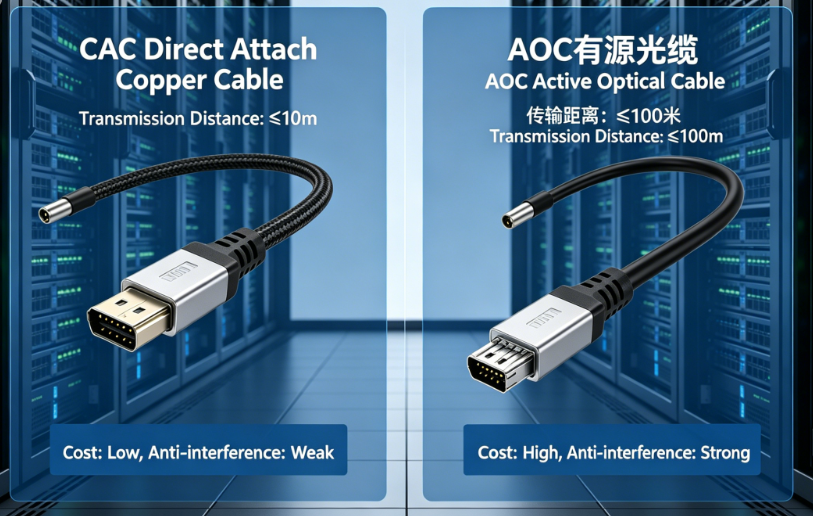
Understanding the Basics: Core Definitions of DAC and AOC Cables
To make the right choice between DAC and AOC cables, you must first understand their fundamental differences—their core transmission media differ, which determines their vastly different application scenarios. This is also the point where beginners are most likely to get confused; clearly distinguishing their definitions can quickly narrow down your selection.
DAC Cable: Direct Attach Copper Cable, the Cost-Effective Choice for Short-Distance Transmission
DAC cable, short for Direct Attach Cable, is a high-speed connection cable that uses twisted-pair copper as its transmission medium. Both ends are pre-installed with fixed connectors (such as SFP+, QSFP28, etc.), eliminating the need for additional optical modules. It transmits electrical signals directly without requiring an electro-optical conversion process. Common DAC cables on the market are divided into passive and active types. Passive cables lack signal amplification components and are lower in cost; while active types incorporate electronic components that can slightly extend the transmission distance.
As the core characteristics of DAC cables, their primary advantages are low cost, low power consumption, and low latency. They are suitable for short-distance, high-density cabling scenarios, making them the top choice for interconnections within data center racks and one of the most cost-effective options currently available for short-distance high-speed transmission cables.
AOC Cable: Active Optical Cable, a Powerhouse for Medium-to-Long-Distance Transmission
AOC cable, short for Active Optical Cable, is a high-speed transmission cable that integrates an optical module, multimode fiber patch cord, and an active optoelectronic conversion chip into a single unit. Its core functionality relies on a built-in VCSEL laser and PD photodetector to achieve bidirectional conversion between electrical and optical signals, which are then transmitted via multimode fiber (typically OM3/OM4).
Unlike DAC cables, the core features of AOC cables lie in their long-distance capability, interference resistance, and lightweight flexibility. They require no complex debugging or fusion splicing procedures, offering plug-and-play functionality. They easily overcome the transmission distance limitations of copper cables and are widely used for medium-to-long-distance interconnections across cabinets and floors. As the premier choice for medium-to-long-distance high-speed transmission cables, they are particularly well-suited for environments with high electromagnetic interference.
Core Comparison of DAC vs. AOC Cables (Key Selection Guidelines)
When selecting between DAC and AOC cables, many people focus solely on price or transmission speed while overlooking critical factors such as distance, interference resistance, and power consumption, leading to incorrect choices. The following detailed comparison across six core dimensions helps you clearly understand the differences between the two and accurately match your specific needs.
Transmission Media and Principles: Copper vs. Fiber Optics—Fundamental Differences Determine Performance
DAC cables use coaxial copper cables as the transmission medium. Their core principle is the direct transmission of electrical signals without any electro-optical conversion. The signal transmission path is simple, resulting in extremely low latency and minimal power consumption—passive DACs have almost negligible power consumption, while active DACs consume only 0.5–1W. However, the inherent characteristics of copper cables make their signals susceptible to electromagnetic interference (EMI and RFI), and their transmission distance is limited, making them unsuitable for medium- to long-distance applications.
AOC cables use multimode optical fiber as the transmission medium, with the core process being “electrical-to-optical-to-electrical” conversion: electrical signals are fed into a module at one end, converted into optical signals by a laser, transmitted through the optical fiber to the other end, and then converted back into electrical signals by a photodetector. As an insulating medium, optical fiber is completely immune to electromagnetic interference and exhibits extremely low signal attenuation. However, due to the need for electro-optical conversion, power consumption is slightly higher (1–2 W), and latency is also slightly higher than that of DAC cables.
Transmission Distance: Choose DAC for Short Distances, AOC for Medium to Long Distances
Transmission distance is the key criterion for selecting between DAC and AOC cables. The significant differences in their distance limitations directly determine the boundaries of their applicable scenarios:
DAC Cable: Due to signal attenuation in copper cables, transmission distances are limited. Passive DACs typically support connections within 7 meters, and at 100G speeds, this is even restricted to within 5 meters; active DACs can extend to 10–15 meters, but as speeds increase, distance limitations become more pronounced, making them unsuitable for cross-rack or cross-floor transmission.
AOC cable: Leveraging optical fiber technology, transmission distances are significantly extended. Multimode AOCs typically support transmission over 20–100 meters, with some high-end models reaching up to 300 meters. Even at high speeds like 100G and 400G, they can reliably transmit signals up to 100 meters, making them perfectly suited for cross-rack and medium-to-long-distance interconnections within data centers. They are the top choice for high-speed cross-rack transmission cables.
Cost and Cost-Effectiveness: DAC is more cost-effective for short distances, while AOC offers greater advantages for medium to long distances
Cost is a key consideration for many enterprises when selecting products. The cost difference between DAC and AOC cables primarily stems from their core components:
DAC cable: The core components consist of copper cables and simple connectors, resulting in low manufacturing costs. The price is typically 1/2 to 1/5 that of an AOC cable of the same specification. Passive DACs, in particular, offer excellent value for money and are suitable for scenarios with limited budgets and short-distance transmission (such as connecting servers to switches within a cabinet).
AOC cable: It includes core components such as optical modules, optical fibers, and active chips, resulting in higher manufacturing costs and a higher initial investment compared to DAC cable. However, in medium-to-long-distance scenarios, AOC eliminates the need for additional optical modules and patch cords, reducing the investment in intermediate equipment. In the long run, this actually lowers overall operational and maintenance costs and avoids the need for secondary cabling caused by insufficient copper cable length.
Other Key Differences: Comparison of Cabling, Interference Resistance, and Maintenance
In addition to the core dimensions mentioned above, DAC and AOC cables also exhibit significant differences in cabling flexibility, interference resistance, and maintenance difficulty, which directly impact operational efficiency:
Cabling flexibility: AOC cables are compact, with a diameter of only about 3 mm and a weight of 1/2 to 1/4 that of a DAC cable of the same specification. They have a small bending radius, making them suitable for high-density cabinet cabling and minimizing obstruction of cabinet airflow; DAC cables are relatively thick (diameter of 6 mm or more), becoming thicker as data rates increase. They are difficult to route in high-density cabinets and are not easily bendable.
Interference Resistance: AOC cables are completely immune to electromagnetic interference, making them suitable for environments near large machinery or high-power equipment, with extremely stable signal transmission; DAC cables are susceptible to electromagnetic interference, which may degrade signal quality, so they should be used with caution in high-interference environments.
Maintenance Difficulty: Both feature an integrated design that cannot be disassembled for repair; in the event of a failure, the entire unit must be replaced. However, DAC cables have a simple structure, low failure rates, and low maintenance costs; AOC cables’ core components are sensitive to temperature and humidity, making them suitable only for standard data center environments. Extreme temperatures or humidity may cause optical components to fail, so proper environmental control is essential.
DAC vs. AOC Cable Selection Guide: Match to Your Needs, Avoid Wasting Money
After reviewing the above comparison, you should now have a clear understanding of DAC vs. AOC cables. The core principle of selection is “matching based on needs”—do not blindly pursue high-end options or focus solely on price. By considering factors such as transmission distance, deployment environment, and budget, you can select the most suitable cable. Below are specific recommendations for different scenarios that you can apply directly.
Three Scenarios Where DAC Cables Should Be Prioritized
1. Short-distance transmission (≤7 meters): For example, connecting servers to switches within the same rack or short-distance interconnections between adjacent racks. Especially for speeds of 100G and below, passive DAC cables offer the best cost-performance ratio and meet low-latency, low-cost requirements;
2. Scenarios with limited budgets: Small data centers and enterprise office networks with modest transmission distance requirements that prioritize cost-effectiveness. Prioritize passive DAC cables to significantly reduce initial investment;
3. Scenarios requiring low power consumption and low latency: Such as high-performance computing and financial trading systems, which are latency-sensitive. Since DAC cables do not require electro-optical conversion, they offer lower latency and extremely low power consumption, meeting the demands of these scenarios.
Three Scenarios Where AOC Cables Are the Preferred Choice
1. Medium-to-long-distance transmission (≥3 meters, especially >7 meters): Such as inter-rack and inter-floor connections, or interconnecting switches in a data center’s spine-leaf architecture. AOC cables ensure stable transmission without the need for additional signal amplification equipment;
2. High electromagnetic interference environments: Such as industrial control systems or server rooms located near large equipment. AOC cables are completely immune to electromagnetic interference, ensuring signal integrity and preventing data transmission errors;
3. High-Density Cabling Scenarios: In ultra-large data centers and AI computing clusters, where cabling is densely packed within racks, AOC cables are lightweight, slim, and flexible to install. They reduce rack space occupancy and improve heat dissipation efficiency.
DAC vs. AOC Cables—No Superiority, Only Suitability
In summary, there is no absolute superiority between DAC and AOC cables; the key lies in matching them to specific application scenarios: DAC cables excel in “short distances, low cost, and low latency,” making them the best value-for-money choice for short-distance interconnections within cabinets; AOC cables excel in “long distances, interference resistance, and high flexibility,” making them the go-to solution for medium-to-long-distance interconnections in complex environments.
When selecting cables, many companies either blindly pursue the long-distance advantage of AOC, leading to wasted costs in short-distance scenarios; or they focus solely on the low price of DAC, resulting in failed cabling for medium-to-long distances and skyrocketing maintenance costs later on. By understanding the core differences between the two and considering transmission distance, budget, and environmental requirements, you can easily make the right choice—ensuring stable network operation while controlling costs and achieving efficient cabling.
If you’re still unsure which cable is best suited for your specific scenario, consider your exact transmission distance and speed requirements to explore the detailed specifications of DAC and AOC cables. By making a precise match, you can avoid common cabling pitfalls!